 Korean Ssaem
Teach You a Lesson: The Korean Behind the K-Drama

When school violence, unchecked bullying, and collapsing classroom authority reach a boiling point, what happens when the government steps in with extreme measures? That is the premise behind Teach You a Lesson, known globally by its webtoon title Get Schooled and in Korean as 참교육 (cham-gyoyuk). For viewers drawn to raw vigilante-justice stories and social thrillers, it has become one of the most talked-about Korean productions — and it is unusually rich material for a Korean learner, for reasons the plot summary does not make obvious.
The premise: a bureau for school justice
Set in an educational landscape where teachers are powerless and juvenile offenders exploit legal loopholes, the government establishes a specialised task force: the Educational Rights Protection Bureau. Field supervisors like the uncompromising Na Hwa-jin are sent directly into troubled classrooms to restore order and protect victims through non-traditional, often physical intervention.
- Vigilante justice meets institutional authority. Unlike lone-wolf anti-heroes, the protagonists operate under a government mandate, which blends courtroom drama with street brawls.
- Real-world issues. The story confronts cyberbullying, elite privilege, academic extortion, and gang infiltration in high schools.
- Immediate consequences. Conflicts move fast, and malicious bullies face undeniable results.
Why it lands with Western audiences
Viewers who know teen dramas like Euphoria or Skins will find this a different animal:
- Grounded action choreography that turns classroom corridors into battlegrounds.
- Complex anti-heroes who are hardened tacticians rather than traditional educators.
- Sharp social critique of systemic failure, parental neglect, and the pressure placed on Korean students.
Webtoon origins
The property began as a Naver webtoon and gained an international following for its bold storytelling. The live-action adaptation keeps the character dynamics while deepening the investigative and legal thriller elements. If you are reading the webtoon alongside the show, you are getting the same Korean twice in two registers, which is more useful practice than it sounds.
The Korean behind the title
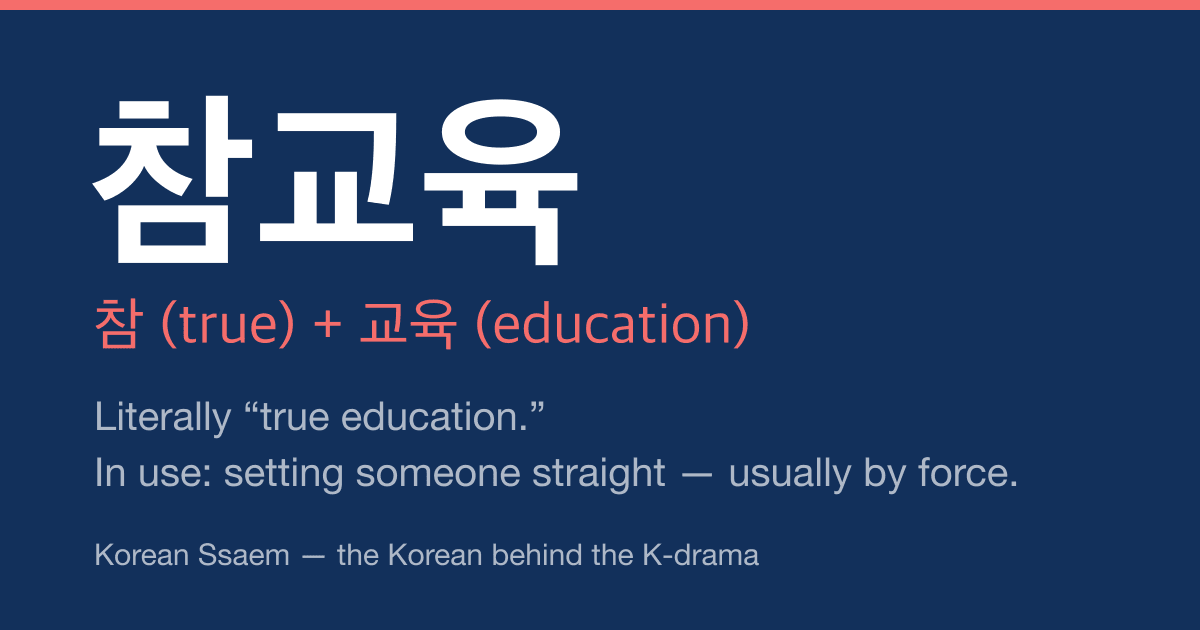
참교육 (cham-gyoyuk) is built from 참 (cham), meaning true or genuine, and 교육 (gyoyuk), meaning education. Read literally it is "true education." In everyday Korean it has drifted into something closer to "setting someone straight" — usually by force — which is exactly the show's premise, and the reason the title is a joke that a dictionary will not explain to you.
This drift is common and worth expecting. A compound that looks formal on paper picks up an ironic street meaning, and the gap between the two is where learners get caught.
선생님, 쌤, and why this site is called Ssaem
선생님 (seonsaengnim) is the full, respectful word for teacher. 쌤 (ssaem) is what it collapses into when students talk to or about a teacher they are comfortable with — and it is where this site's name comes from. Learners almost always meet 선생님 first, never learn 쌤, and then find school dramas full of it.
The choice is about relationship rather than politeness alone. 쌤 in the wrong room sounds flippant.
Watch who speaks 반말 to whom
Korean makes you choose a speech level in every sentence you utter. 존댓말 (jondaenmal) is deferential speech; 반말 (banmal) is the plain speech used with close friends, with children, or downward across a hierarchy. There is no neutral option — declining to choose is itself a choice.
In this show that choice is a weapon. An adult who drops into 반말 with a student is asserting authority over them. A student who answers in 반말 is picking a fight. Once you can hear the switch, whole scenes stop being about what is said and start being about who is allowed to say it.
학폭, and how Koreans actually shorten things
학교폭력 (hakgyo pongnyeok), "school violence," is the formal term you will see in a news report or a government document. In speech and in headlines it is almost always shortened to 학폭 (hakpok).
Korean abbreviates aggressively like this, and the short forms are what people actually say. A learner who studies only full forms understands the documentary and misses the conversation.
Take the vocabulary with you
Everything above is the reasoning. The words themselves are easier to keep in a sheet you can print and mark up, so there is one:
Download the K-content vocabulary study guide (PDF, 2 pages)
It is bilingual and sorted by level, and it gives the literal meaning before the figurative one — 고구마 is a dry roasted sweet potato that sticks in your throat, 사이다 is the soda that washes it down — which is the point at which these stop being arbitrary. Level 1 covers the fan vocabulary you meet immediately — 사이다 and 고구마 for a satisfying or a maddening plot turn, 정주행 for a binge, 엔딩 맛집 for a show that lands every cliffhanger, 일진 for the school bullies this drama is built around. Levels 2 and 3 move to the terms the plot actually turns on: 교권, 촉법소년, 체벌 금지, 사적 제재.
No sign-up, no email. Print it, write on it.
Looking for more? The resources page collects every free download like this one in one place.
What not to copy
Drama dialogue is written to generate conflict, which makes it excellent input and unreliable instruction. The confrontational 반말 that drives these scenes is genuinely rude directed at a stranger, a colleague, or anyone older than you. Watch for it, learn to hear it, and do not reach for it.
That distinction — what a drama teaches you to understand versus what it teaches you to say — is the one worth carrying into everything you watch.