 Korean Ssaem
Why Koreans Ask Your Age First
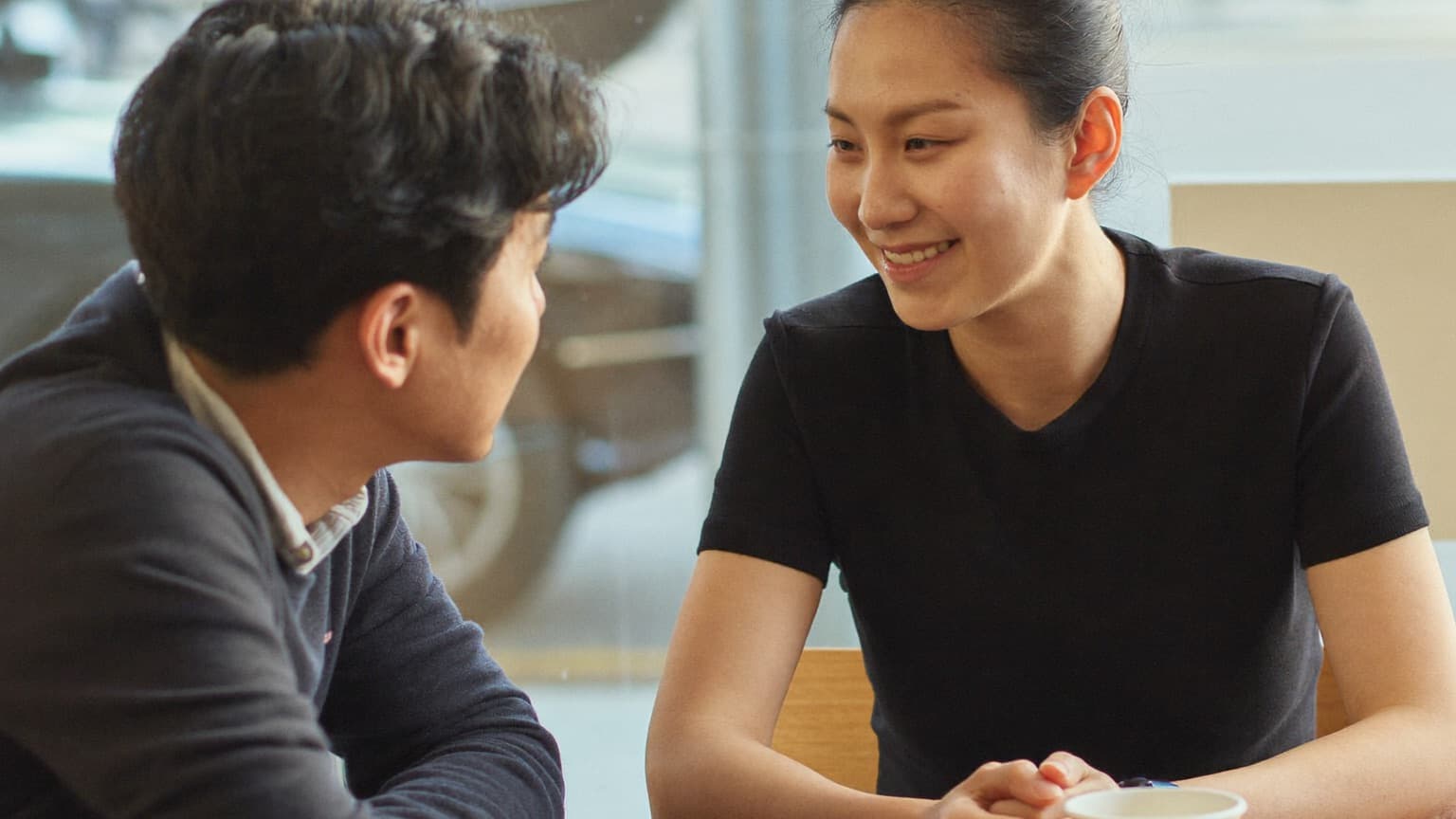
Ask an English speaker their age in the first five minutes and you have been rude. Ask a Korean speaker, and you have been practical. The question is not about you. It is about which language the two of you are going to use.
Korean makes you choose before you speak
English lets you talk to anyone without deciding anything about them first. "Did you eat?" works for a stranger, a child, and your grandmother.
Korean does not offer that. Nearly every sentence has to be finished in one of several speech levels — broadly 존댓말 (jondaenmal), the polite register, and 반말 (banmal), the plain one used with close friends and with people younger than you. The ending you choose says how you are positioning yourself relative to the person in front of you.
There is a safe default: the 해요 (haeyo) ending is polite without being stiff, and a beginner can use it with almost anyone. But it is still a choice, and a Korean speaker hears it as one. What Korean will not let you do is finish a sentence while staying neutral about the relationship.
So the age question is not small talk that got out of hand. It is the information a Korean speaker needs before the first real sentence can be finished.
What is actually being worked out
Age matters here less as a number than as a boundary, and one year is enough. Two people born in the same year can settle into 반말 quickly. A single year of difference puts them into a different arrangement, with its own vocabulary for the relationship itself.
Which word you use depends on your own gender as well as the other person's:
- A man calls an older man 형 (hyeong) and an older woman 누나 (nuna).
- A woman calls an older man 오빠 (oppa) and an older woman 언니 (eonni).
At school or at work the same boundary appears as 선배 (seonbae), someone senior to you, and 후배 (hubae), someone junior. Using these words is warm rather than formal — closer to calling someone by name than to calling them "sir".

None of this is about deference in the way English speakers usually imagine. Being the younger one is not a demotion. It carries expectations in both directions, and Koreans generally find the arrangement comfortable rather than constraining, because it settles a question that would otherwise sit unresolved through the whole conversation.
Answering it without feeling interrogated
Three things make this easier.
Give the year, not the age. On 28 June 2023 South Korea standardised on international age — 만 나이 (man nai), counted from zero at birth — across judicial and administrative life. Before that, three systems ran side by side: 세는나이 (se-neun nai), where you were one year old at birth and gained a year every 1 January; 연나이 (yeon nai), your age by birth year alone, still used for things like school year and conscription; and 만 나이. Many Koreans still hold more than one of these in their heads, so an age given in years can be ambiguous. A birth year never is.
The two questions you will actually hear:
- 몇 살이세요? (myeot sal-iseyo) — how old are you?
- 몇 년생이세요? (myeot nyeonsaeng-iseyo) — what year were you born?
And the answer that ends the ambiguity:
- 저는 ___년생이에요 (jeoneun ___ nyeonsaeng-ieyo) — I was born in ___.
Expect it early and let it be quick. The question tends to arrive near the start precisely so it can be gotten out of the way. Treating it as a small administrative step, rather than as something to deflect, ends it faster than any polite dodge.
Ask it back. It is not intrusive in return. A conversation where only one person's position is known is the awkward one.
Why this belongs in your first month
Beginners usually meet speech levels as a grammar table — a column of endings to memorise, with a note that one of them is polite. Learned that way they feel arbitrary, and they are the first thing to collapse under pressure in a real conversation.
They are much easier to hold onto once you understand that they encode a relationship the language insists on establishing. The endings are not decoration on top of the sentence. They are the sentence telling the truth about who is speaking to whom.
Which means the age question, the thing that feels most foreign about a first Korean conversation, is also the most direct way into the grammar that gives learners the most trouble.